
Pop Culture Medicine is a segment that looks at representations of the medical field in media. Today’s Topic: The Psychiatry of Addiction and HBO’s Euphoria
Addiction
/əˈdɪkʃ(ə)n/
noun
- : the condition of being unable to stop using or doing something as a habit, especially something harmful (Oxford English Dictionary)
- : a compulsive, chronic, physiological or psychological need for a habit-forming substance, behaviour, or activity having harmful physical, psychological, or social effects and typically causing well-defined symptoms (such as anxiety, irritability, tremors, or nausea) upon withdrawal or abstinence : the state of being addicted (Merriam-Webster)
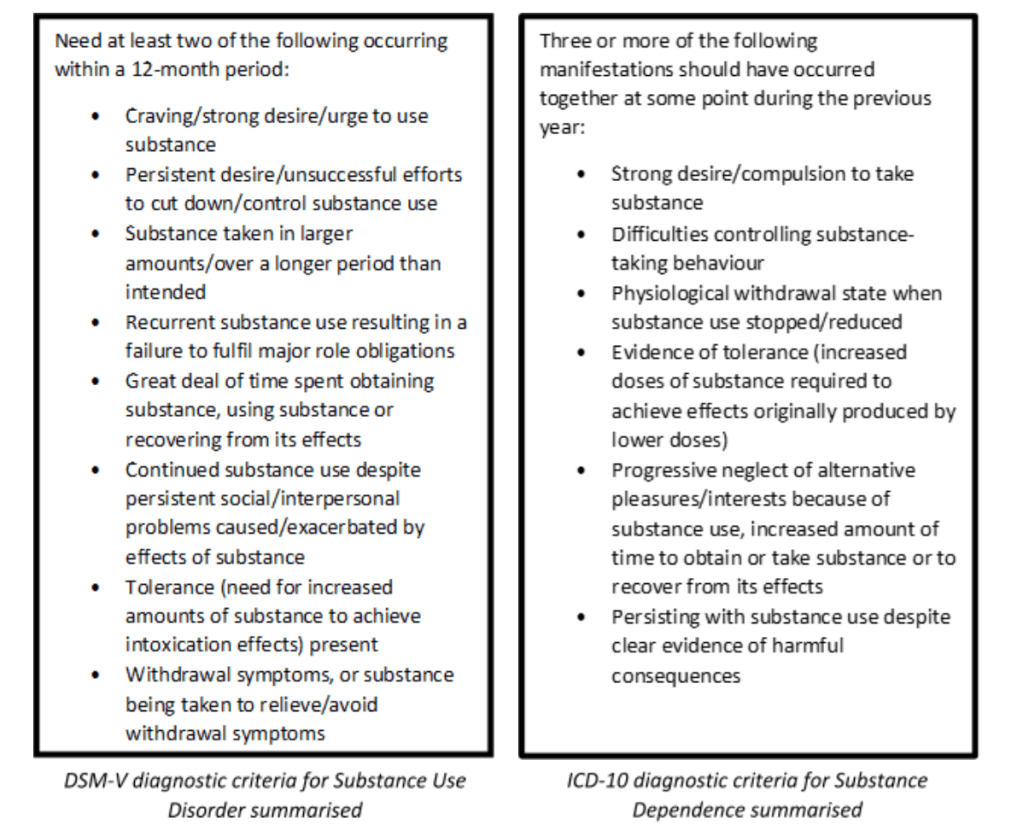
Addiction as shown by the definitions outlined above from two prominent English dictionaries, is generally in reference but not limited to compulsive use of some sort of substance. Within the medical community, the consensus has become that addiction is a medical condition which has clearly defined diagnostic criteria which are outlined in the DSM-V under “Substance Use Disorder” and ICD-10 under “Substance Dependence” (these are diagnostic manuals of sorts used by doctors) which requires treatment via an integrated multi-disciplinary approach. This consensus is based on decades of research, primarily animal studies, which is still on-going to this day which has provided a robust evidence base including demonstrating the neurobiological changes predominantly of the reward and motivation neurological systems associated with addiction.
But whilst within the medical community and the broader scientific community addiction is now generally understood and accepted to be a medical disorder that requires treatment, society hasn’t quite caught up to this view. The general population views addiction through a moral lens, that is to say they view it as an individual moral failure which results from lack of willpower or loss of control; it usually takes people personally going through the experience of having an addiction, or having a close friend or relative go through the experience to alter people’s perception of addiction. This moralistic view of addiction is dangerous as it leads to the ostracization and social isolation of people with an addiction when what they need is compassion. Furthermore, the view that drug addiction is a moral failure has led to the criminalisation and incarceration of drug users globally (bar a few notable exceptions) with the net result being that people with drug addictions are punished socially and criminally. And in the context of the current opioid epidemic which has seen a widespread increase in addiction to opioid drugs specifically, it is clear that we as a society are failing to help people with addiction and there needs to be an overhaul in the way we view it and those with addiction.
Which is where media comes in. The media we consume has the ability to shape our identity and inform our views, politics and beliefs – obviously not on its own, it doesn’t exist in a vacuum but rather forms part of a range of factors including familial and social relationships, our environment, education etc. that influence us directly and indirectly. Hence, media can be a powerful tool in helping to bring light to issues that people would otherwise not be exposed to and help to destigmatise them, drug addiction being a prime example of this. There has been a myriad of films and television shows that have portrayed drug addiction (‘Trainspotting’, ‘Requiem for a Dream’, ‘Basketball Diaries’, ‘Beautiful Boy’, ‘Heaven Knows What’, ‘Nurse Jackie’, and so on) but of these only a fraction have looked at addiction amongst people of colour specifically Black people, much less young Black people. If addiction is stigmatised and demonised amongst White populations, the attitudes it is met with when it’s Black people with addictions are far, far worse – you only have to compare and contrast public/governmental reactions to the crack epidemic which predominantly affected Black inner city neighbourhoods in the US from the 1980s through to the 1990s, to the current opioid epidemic which has by in large affected White people more than Black people to see a clear example of this difference.
It is this lack of media representation of addiction amongst people of colour and Black people in particular which to me makes HBO’s show ‘Euphoria’ stand out, at least where the storyline of the show’s protagonist Rue Bennett portrayed incredibly by Disney alum Zendaya (that’s Emmy winning actress Zendaya, to you) is concerned. Right from the outset of the show in the pilot when we’re introduced to Rue, we’re shown her getting diagnosed with a range of mental health disorders including Generalised Anxiety Disorder, Obsessive Compulsive Disorder (OCD), Attention Deficit Disorder (ADD) and possibly Bipolar Disorder for which she’s given prescription medication for from a very young age (there’s a conversation to be had about the possible over-diagnosis and over-medication of children in Western culture demonstrated in the show, but that is beyond the scope of this essay). The show goes even further by having Rue explain that for her, drugs quieten the constant buzzing in her head of her anxiety or in her own words give her “two seconds of nothingness”. Through this, the show quickly and very clearly dismisses the misguided notion that all people with drug addiction seek out drugs for hedonistic reasons and develop addictions because they simply lack the willpower to say no/to stop, whilst simultaneously introducing audiences to what’s known in Psychiatry as a “dual diagnosis” where drug addiction co-exists with other mental health disorders, most commonly anxiety and depression.
Along with using illicit drugs to self-medicate for her mental health disorders, the origins of Rue’s drug use are revealed to be linked to her father’s terminal illness and subsequent death suggesting that for her, the drugs help her deal with both her mental health and her grief over her father. Within Psychiatry, factors which drive drug use in people with addiction are broadly categorised into either positive reinforcement which refers to the rewarding aspects of drugs, the “euphoria” if you will, and negative reinforcement which refers to the less pleasant drivers such as relief from stress, anxiety and depression amongst other factors; for Rue, it is evident that her drug addiction is driven by this so-called negative reinforcement. In this way, Euphoria carefully portrays the complexities of drug addiction by showing the relief from life they can bring to users which makes drugs so appealing, and it does so in an empathetic, non-judgemental way and without trying to preach an “abstinence is the best policy” type message to its audience. However, whilst it doesn’t take an abstinence-only approach to its portrayal of addiction, the show also shows that for as much as they bring relief for Rue in the quietening effect they have on her anxiety-addled mind, what makes drugs appealing is what also makes them destructive to the person using as in the overdose Rue had over the summer which kicks of the show’s story, and destructive to the people close to the person with an addiction as in the breakdown of Rue’s familial and social relationships with her mother, her sister, her childhood best friend Lexi and even how it impacts her romantic relationship with Jules.
This dichotomy of the solace and euphoria drugs bring with the destruction they leave in their wake for the person with the addiction along with their loved ones is perfectly showcased throughout the show throughout all its different elements in a way so meticulous that it could have only been all co-ordinated by someone with personal experience of drug addiction, that being the show’s creator Sam Levinson whom a lot of Rue’s story is largely based on. One example of the way the show does this is through the editing which shows the way everything almost seems to slow down, to quieten, when Rue is on drugs but at the same time, the show almost always undercuts that with scenes showing the negative consequences of her drug use including multiple fights with her mother via two memorable montages in 1×02 and 1×08, along with the scene of her overdose where her little sister found her. The makeup and wardrobe also aid in this, with the way they’re able to have 24-year old Zendaya go from looking young and fresh in the flashback scenes when she’d look after her ailing father, to having her look physically and mentally worn down through the effects of her drug addiction.

Speaking of Zendaya, whilst all the elements such as the writing, editing, hair and makeup, and wardrobe all undoubtedly help to portray all the facets of drug addiction, none of it would work without her performance which is the heart and anchor of the show. From the more comedic moments of Rue working the case of Nate Jacobs as an old-timey, chain smoking detective in the depths of her manic episode, to the dramatic and emotional scenes of her threatening her mother with a piece of broken glass during a heated fight (a scene which was improvised, by the way), to the quieter, heart breaking moments like her standing in Jules’ room, open and vulnerable, telling her she doesn’t want to lose her just to name a few; Zendaya brings a depth and complexity to Rue that shows that she’s multi-layered and palpably, painfully human. The impeccable work Zendaya does presents Rue as more than her drug addiction (and her other mental health disorders); it humanises her and invites the viewer to sympathise and empathise with her in a way we rarely get to see for Black people, particularly young Black women, with addictions on-screen.
There have been criticisms levied at the show’s portrayal of drug addiction including that it glamourizes drug use because of its flashy, pretty aesthetics and because it does not directly warn against using drugs (which I clearly disagree with but art is subjective, as is what we take away from consuming it so I will not spend time vehemently arguing against this take) along with this article which I think made some valid points about Euphoria’s shortcomings in portraying how complex and lengthy the treatment of drug addiction actually is in reality. Overall whilst some of these criticisms may be valid, the show has only had one season to tell its story thus far and more importantly, it is not some sort of public health campaign to educate the masses on the ins and outs of drug addiction and its treatment, and drug addiction like with any disorder, physical or mental, is not a one size fits all and the show portrays an experience specific to Sam Levinson so is not meant to be a universal depiction. Ultimately, I feel that the show achieves its main goal which is to destigmatise drug addiction and humanise those with drug addiction. It’s there in the show’s slogan—“feel something”. Kindness, compassion, empathy.

 Small, Silver and Hardback
T- I really admired your approach to this article and topic, and definitely agree that while art is subjective and anyone can have an opinion about the show and its dramatics, euphoria is definitely successful in eliciting feeling from its audience, and presenting its characters as fully nuanced human beings moving through the highs and lows of adolescence. I also like that you included praise for the makeup and costume departments, who had to get incredibly creative in making the show equally realistic and ostentatious- and no doubt were successful at creating a visual narrative for Rue at her most vulnerable moments. (Shoutout to the makeup team on their well deserved Emmy win!) And thank you for a thorough yet simplified and easy to read analysis on the psychiatry of addiction- a difficult topic to write, read and consume but incredibly important to understand. I hope that the show as it exists and prevails- continues to encourage its wide audience to practice more patience and empathy in their daily lives. ❤️
LikeLiked by 1 person
Ma’am. The way you wrote this T!!!!
I have such big views on drug addiction and addictions in general. It’s so refreshing to see someone else take a similar approach to it as I would.
There’s so many tv shows that portray drug addicts as heartless and mean and failures, and obviously some are. But there’s those kinds of people in all walks of life. Addicts need help and compassion and love. They deserve it. Being a drug addict doesn’t make you a bad person.
Lemme chill for a sec before I ‘In this essay I will…’
I loved this. Okay thanks love you x
LikeLiked by 1 person
Beautifully written; sparked great conversation with my sister on my own prejudice against people suffering different forms of addiction and the way we view drug and alcoholism differently sometimes as a society. Even the language we use when we think of the phrase ‘drug abuse’ words mean things we must destigmatise our language. Have you ever seen the 1995 film Kids? Would love to hear your thoughts on it.
LikeLiked by 1 person
I’m sorry to only be responding to this over a month later, I’m very bad at using WordPress. Thank you for very kind words, it’s touching to hear that the essay sparked important conversations. I have seen ‘Kids’ and I think it’s very similar to ‘Euphoria’ (or rather, Euphoria is very similar to Kids since it preceded it lol) in that it put a spotlight on issues faced by young people at the time to bring them to the attention of the general public. Like with ‘Euphoria’, it didn’t necessarily depict what life was like for all or even most young people but illuminated important issues nevertheless.- T
LikeLike
Wow I really enjoyed this essay. I found it to be very nuanced and carefully written. I especially liked the assertions made between events in the show and the effect they have in the public opinion. I wholeheartedly believe that narrative has a transformative power; thus making the representation of drug addiction as more of a mental health problem than a symptom of moral bankruptcy, all the more important. After all is in these stories were we create and draw the narratives that define ourselves. Your point about the show not being some kind of “health campaign” is also especially good considering how little drug addiction stories, specially those about young black people, are treated with empathy. Great read!
LikeLiked by 1 person