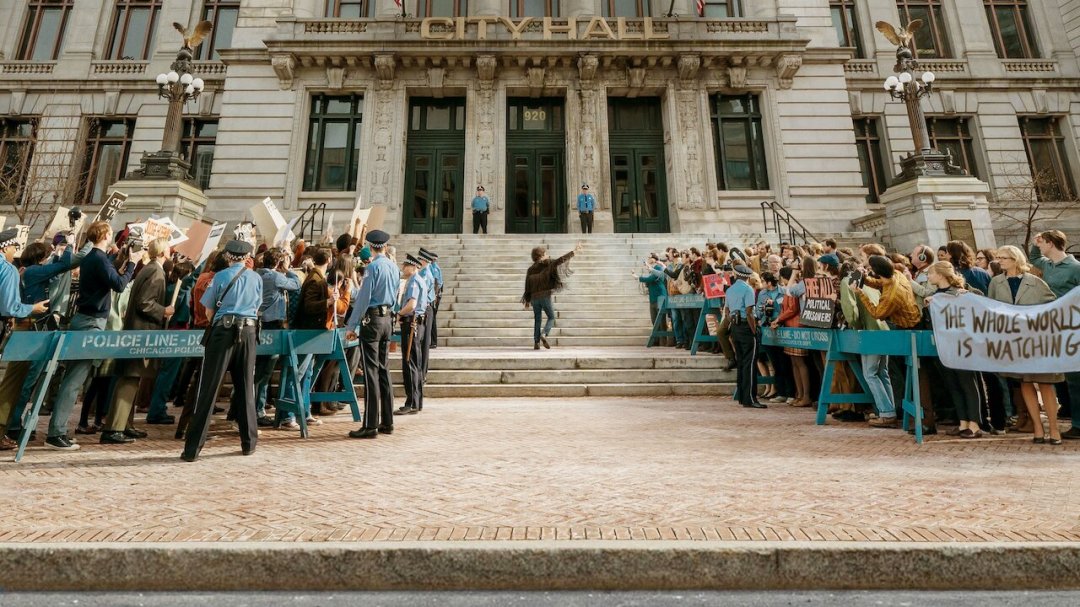

There are very few screenwriters who are well known and whose writing style is so recognisable that there are courses on it and their writing style is fodder for parody. This is what makes Aaron Sorkin different to other screenwriters- he has a very specific, recognisable writing style with the quippy, fast-paced and overlapping dialogue that has allowed him to have a successful career spanning three decades. Unfortunately, whilst Aaron Sorkin the writer may be prolific and hailed by many, his first foray into directing with ‘Molly’s Game’ left a lot to be desired (I still haven’t watched the film in its entirety to this day) and whilst his latest effort ‘The Trial of the Chicago 7’ is certainly an improvement from the 2017 drama, I still believe Aaron Sorkin the writer is leagues better than Aaron Sorkin the director.
The latest Netflix drama, as the title suggests, focuses on the trial of seven (plus Bobby Seale whose involvement was down to the inherent racism of the criminal justice system) social activists who were involved in a protest at the 1968 Democratic National Convention. The drama has a star-studded ensemble cast who all gave superb performances and helped bring to life Sorkin’s instantly recognisable dialogue on the screen in a film I found to be entertaining, at least for the first half. Instead of telling the story chronologically by showing the protest first then the trial proceedings that followed after, the film was structured so that the audience found out information as it came up in court and as it came up during Abbie Hoffman’s quasi stand-up routine. I liked this non-linear narrative structure the film took as it meant, ignoring the fact that the film is based on real events that a lot of us went into the film with some prior knowledge of, that we got to find out information as the people observing the court proceedings would have.
As previously mentioned, the cast all gave solid performances and were generally able to deliver Sorkin’s fast-paced, witty dialogue which is a challenge some actors can balk under the pressure of. However, there were standouts among the performances to me, including Sacha Baron Cohen, Jeremy Strong, Mark Rylance and Michael Keaton (the latter’s appearance late on in the film was a pleasant surprise). The biggest standout performance-wise was by far Yahya Abdul-Mateen II who played co-founder of the Black Panther Party Bobby Seale, a man who had no involvement with the other seven defendants and wound up being arrested and lumped in with them only as a result of the inherently racist and prejudicial police and criminal justice system. He appeared in the film briefly, only during the courtroom scenes and only up until a mistrial was declared in Seale’s trial, but he managed to make an impact as a man who had the additional burden of his race on top of his political activism to contend with. Yahya expertly showed Seale’s growing frustration and anger with his continuous mistreatment, and how he he tried his best to control his reaction to avoid further unwarranted punishment from the prejudicial judge until things hit a boiling point in what was easily the film’s most memorable and impactful scene, when a mistrial was declared. Even with such a brief appearance, he outshined everyone else that he so much as shared the frame with so much that I became much more interested in him than the titular “Chicago 7”. There was a much more interesting story to be told about the judicial system’s poor treatment of men of colour, Black men in particular, that was present back in the 1960s and is still very much present today and that was the story I wanted to see versus the story we got instead. I am torn because whilst this is a story that I wanted to see told, I also don’t think I would’ve wanted to see it told by a White filmmaker. That didn’t stop me from wishing Bobby Seale was the film’s focal point nor did it stop my interest from dwindling down once he subsequently left the story.
Likely because of my main point of interest in the film being removed in Yahya Abdul-Mateen as Bobby Seale’s exit, I generally found the latter half of the film way less engaging than the first. Without the distraction of Bobby Seale’s story all that was left was a film that, in its attempts to be relevant to the current political climate, ended up presenting an account of events that was lukewarm and bordering on centrist with the way it toned down a lot of the leftist radical politics of the figures it was depicting. A key example of what I mean is the film having Abbie Hoffman, played by Sacha Baron Cohen, say that he believes that governmental institutions are “…wonderful things that right now are populated by some terrible people…”; it is clear that this was Sorkin’s less-than-subtle way to make direct reference to the current Trump administration but to have Abbie Hoffman, a man who was famously and publicly anti-imperialist, anti-capitalist and critical of institutions of American democracy, make such a statement/water down his political stances is downright insulting. This is just one example of many instances of this.

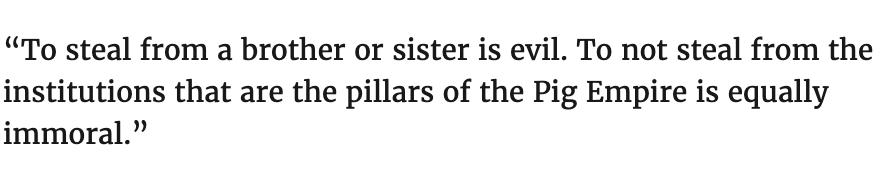
The film opted to tell a feel-good story that ended up being a watered down version of actual events at best, and a misrepresentation and insult of the very real figures depicted and their politics at worst. Maybe in the current climate of American and global right-wing politics and general social upheaval this is the kind of story that some people want and/or need right now. I’m also aware that during a time where the main priority in U.S politics is increasing voter turnout it may have been a slippery slope to show a film that was outright critical of the government and the institutions that comprise it, but to me this film’s politics ended up underwhelming me. It may seem unfair to judge the film based on politics but film doesn’t exist in a vacuum so I cannot simply separate the two. And though I may have found the film entertaining with the sharply written dialogue and great performances, I unfortunately can’t put aside my feelings about the politics of it all and that has affected my overall opinion.

 Small, Silver and Hardback