It would be a huge understatement to say HBO’s ‘Euphoria’ has become something of a cultural phenomenon following its first season last year. With its distinct aesthetic style of sprawling camera work, quick-cut editing and “Euphoria makeup” it’s managed to become such a phenomenon that makeup looks inspired by the show were seen on runways across the globe during fashion shows in 2019, and every teen show that’s come after it gets compared to it whether there are similarities or not. The show has even garnered praise within the industry, with the first season earning numerous awards including a historic Outstanding Lead Actress in a Drama Series Emmy for the show’s lead Zendaya (legally known as Emmy Winner Zendaya).
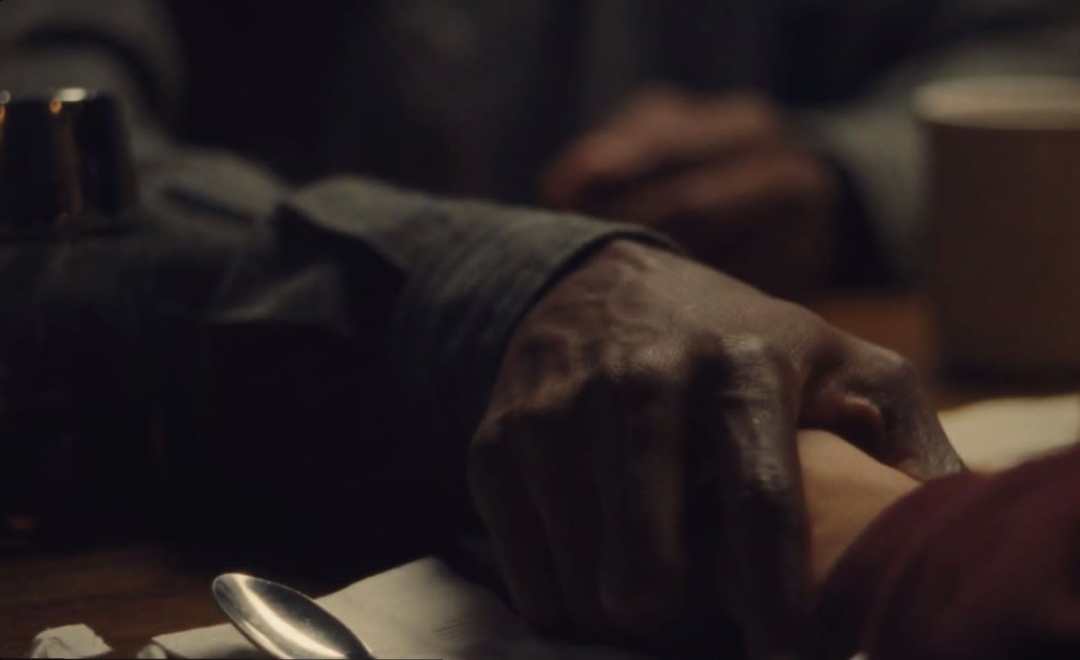
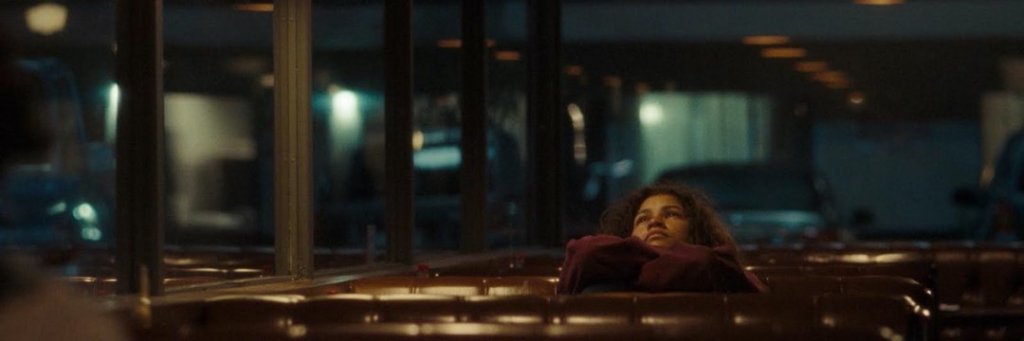
Thus cast & crew, and audiences alike, were itching to dive back into the fantastical world of ‘Euphoria’ with a new season that was due to start shooting in March of this year. Unfortunately, Miss ‘Rona (or as some would call it, “COVID-19”) had other plans and halted production of the show a mere few days before they were due to start shooting the second season. In the wake of the global pandemic, the show’s creator, writer, director and all-around mastermind Sam Levinson, decided to shoot a couple of “bridge” episodes to tide audiences over until it is safe for production of season 2 to resume, whenever that will be. With the virus still ravaging the U.S. and the world alike, Levinson was forced to adapt how they shot the show, which usually involves hundreds of locations and extras, and trim it down to the bare necessities for the sake of health and safety. Enter ‘Trouble Don’t Last Always’, the first of two bridge episodes which apart from a fantasy sequence imagined by Rue of her and Jules’ life together in the city (which in itself only involved two people in a small studio apartment) takes place entirely in and around a single diner and is primarily focused on a conversation between Rue and her Narcotics Anonymous sponsor Ali (played by the indomitable Colman Domingo).
It was certainly a risky change of pace for the show which is usually so relentless with jaw-dropping camera work and a music video-esque editing style where they employ quick cuts from scene to scene, but the end result paid off. Without the lavish aesthetics of the show, the result was an episode that was stripped down to its very core and it didn’t buckle under the pressure of being laid bare. There was no flashy cinematography and make-up to hide behind, and even the soundtrack was used sparingly, though it still remained an integral part of the story the way it was in the first season with the episode being closed off by a heart-breaking rendition of ‘Ave Maria’ from the show’s composer Labrinth. At its heart, Euphoria is a show that seeks to enlighten audiences on the struggles of today’s youth and invites us to feel something as per the show’s tagline, but in the first season I felt that sometimes that message got drowned out by everything else happening around it—the sometimes overwhelming aesthetics, the multiple narratives the show tries to balance at once, the shock-value esque imagery. With all of that removed, the show had room to breathe and explore the disease of addiction and mental health in general in a measured, deliberate way. And whilst the idea of a conversation about addiction between two characters for 45-minutes may not sound all that exciting, I found it to be fully engaging and I was hooked from the moment Rue stumbled into their booth, clearly high. This is a testament to Emmy Winner Zendaya and Colman Domingo who gave performances which came off as effortless and reeled audiences in to something that felt less like two actors reciting a script and more like two people, connected by the painful effects drug addiction has had on them both, having a conversation about addiction, about life.
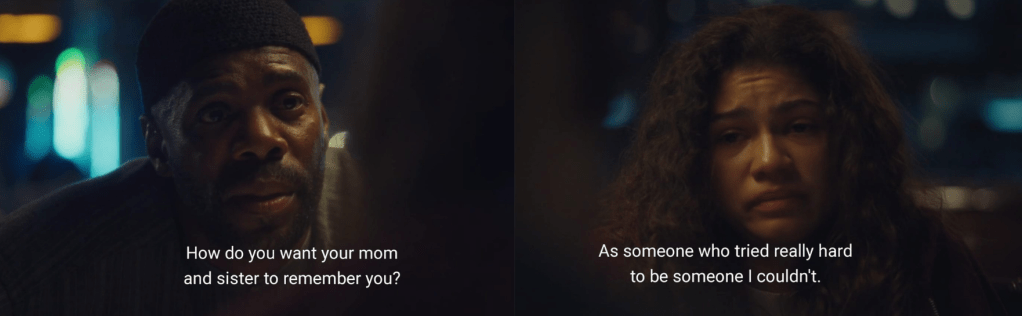
Through Rue and Ali’s conversation, the show was able to explore addiction in depth (something which I’ve written about myself here), exploring the ways in which addiction changes a person and drives them to do out-of-character things like, say, threaten their mum with a shard of glass, in a way that was sometimes difficult to hear but was necessary for the show’s protagonist and the audience. The most striking part of the conversation for me was the discussion about recovery from drug addiction, especially relevant following on from Rue’s relapse that closed off the first season. The conversation between Rue and Ali explored Rue’s reasons for relapsing (it was not Jules’ fault so knock it off) and Ali was able to tease out from Rue that not only does Rue have no desire to get clean, she also has no desire to be alive for much longer, bringing to light the comorbidity of addiction with mental illness. From there on the conversation shifted to discussing life and death as Ali tried to convince Rue not to give up, and at no point did the conversation ever verge into the melodramatic or unrealistic. Ali was brutally honest and harsh at times, yet there was an affectionate warmth underpinning his words that showed that he was speaking from a place of (tough) love for Rue who likely reminds him of his own estranged daughters. Yes, some of the attempts to link Rue’s addiction and sobriety to real-world affairs and politics were stilted and felt slightly out of place (the throw-away lines about women converting to Islam stood out in particular), but Colman Domingo spoke with so much conviction that his message got through to Rue and to the audience in turn. Colman Domingo’s Ali made me want to believe in myself.
This episode was very different from the ‘Euphoria’ we have come to know and love but it was also a much-needed breath of fresh air for the show’s protagonist and for us as the audience. Whilst I can’t see the show adopting this minimalist style for every episode going forward given that the show’s visual style is so integral to the storytelling and not every narrative in the show is well-suited to the bottle episode approach, I think this episode proved that the show can flourish by dialing it down just a smidgen and allowing things to settle and breathe. ‘Euphoria’ is a show that can sometimes feel relentless in its bleakness and nihilism but through this episode the show was able to offer a hopeful outlook for Rue and the other characters who we’ve seen go through dark times, because like Miss Marsha said, “Trouble don’t last always”. That message made this episode uniquely suited to the times we’re living in, having gone through dark times of our own this 2020 with a global pandemic and racial upheaval among other things. This episode provided the audience with a much needed reminder of the power of hope, hope in ourselves and hope for the future.

 Small, Silver and Hardback
One thought on “T reviews ‘Euphoria: Trouble Don’t Last Always’: There is Power in Hope”