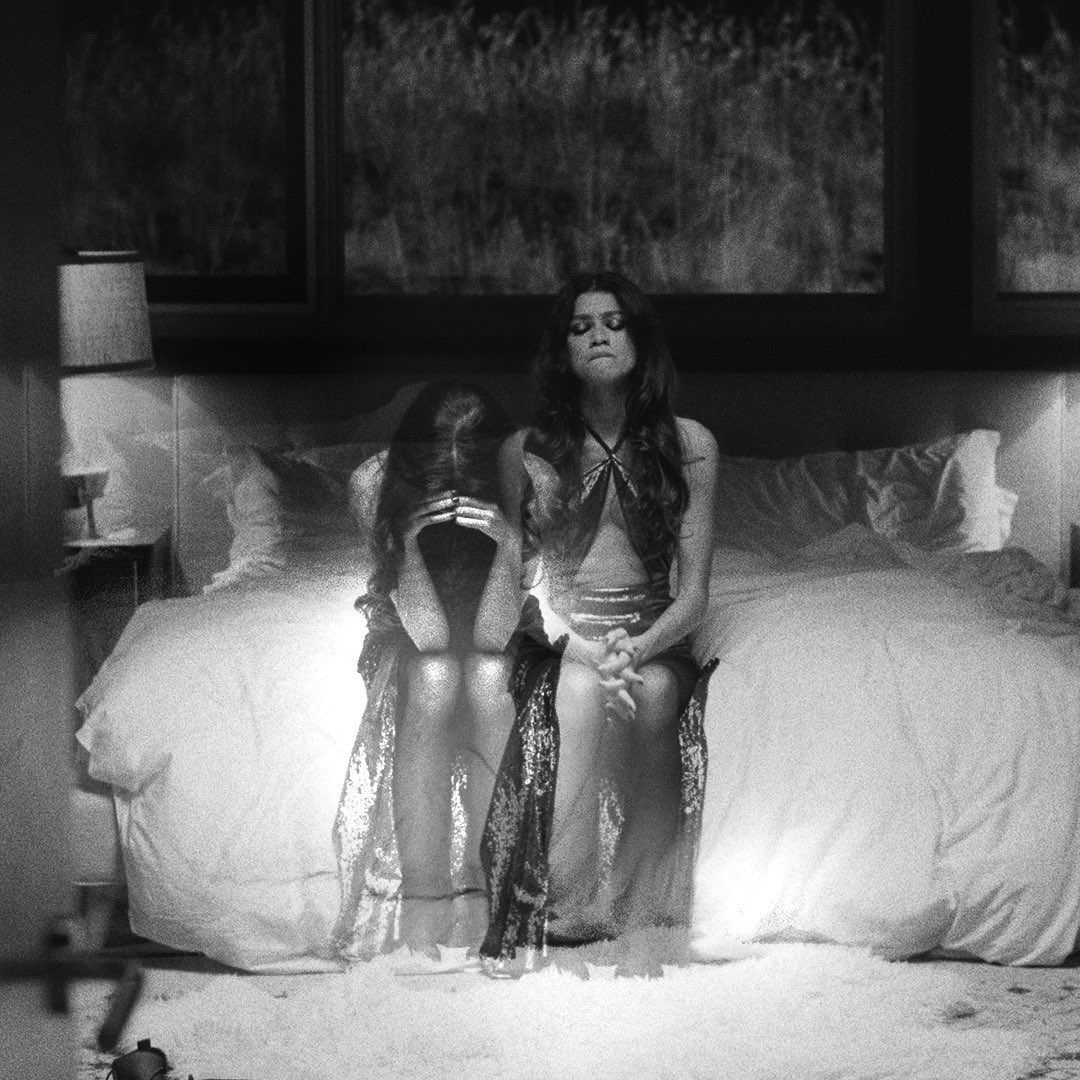
I usually approach these “T reviews” posts by starting with providing some context on the background and production of whatever I am about to review but when it comes to Netflix’s ‘Malcolm & Marie’, I don’t really need to. It’s a film that’s made headlines and been the topic of internet “discourse” for a myriad of reasons; firstly for being the first film to shoot and wrap in the midst of a global pandemic, then again when the trailer was released and it spurned discourse about age gaps and Disney stars, and more recently when it was screened to critics because of a few choice words it had to say about the current state of film criticism (despite the fact that these words were the musings of an insecure, egocentric filmmaker character that are never treated as accurate or infallible within the film itself, and the fact that isn’t what the film is really about). It’s certainly a film that has started debate and discourse on social media, some of it meaningful and necessary, and some of it not so much. But a topic I haven’t seen discussed much, certainly not as much as the topic of what was said about film critics, is how, in my opinion, the film presents a portrait of intimate partner violence that’s not so often talked about or shown in the media— the ways it can be subtle, insidious, and easy to dismiss as not being abuse.
With ‘Malcolm & Marie’ having been filmed under strict COVID restrictions, production was limited to a skeleton crew along with just two cast members, who all quarantined together and stayed in their bubble for the making of the film whilst workshopping it the way you would a play. But this is not the only reason the film feels so much like a play, the presentation of the film itself feels like something off the stage- from the framing and scene blocking that has Zendaya and John David Washington framed in line with classical stage positioning, to the script which consists of prolonged monologues where a character rants and rambles without interruption in a way that’s more in keeping with theatre than a real life fight. And it is within the dialogue, in the way that Malcolm talks to Marie in particular, that we see the emotional abuse inherent in Malcolm and Marie’s relationship. The fight, with its peaks and reprieves, that is the core of this film is one that features low jabs and crossing of lines no doubt, but Malcolm’s words in particular stood out to me. The first inclination of Malcolm’s abusive nature we get is during a scene early on in the film and the fight in which Malcolm hurls verbal abuse at Marie across the house whilst he carelessly eats the boxed mac and cheese she made him. Upon Marie pointing out how he is so callously verbally abusing her, Malcolm dismisses it and mockingly makes a point in distinguishing the abuse as being “verbal”, thereby minimising Marie’s feelings. This flagged up what was to come in the film: Malcolm berating and belittling Marie and her thoughts and feelings, gaslighting her for calling him out for the very obvious theft of her life story for his art and down right questioning her sanity by using a lot of gendered insults we’re all accustomed to men using in relation to women, “unstable”, “crazy” etc. And based on Marie prefacing a question to Malcolm by asking him to answer honestly without “…making me feel like shit”, it’s clearly established that Malcolm belittling her is an on-going pattern within the relationship. In questioning her sanity, Malcolm also does something disturbing and insidious by weaponizing her mental illness, her addiction and her previous suicidality, against her for the sake of winning the “argument”. He throws her lowest moments back at her, uses them against her by reminding her of how he was there for her and how she’d essentially be nothing without him in a way that removes her urgency and removes her own role in her personal recovery from the narrative in a way that perturbs. Helping someone at their lowest is not done out of “love” if you’re just going to constantly remind that person not just of your role in their recovery, but of just how unwell they were and any shitty things they did at the time.

An excerpt from the script in which Malcolm dismisses Marie calling out his abuse, since Netflix won’t let me take screencaps (grow up Netflix).
A lot of discourse surrounding this film has been centred on the age gap- both of the characters of Malcolm and Marie, and of the actors John David Washington and Zendaya- in a way that is more to do with infantilising Zendaya, who many have either grown up with or watched grow up on the Disney channel, than it is to do with a genuine conversation about how the relationships portrayed by Hollywood are skewed towards the men being older and examining the reasons underlying this trend. I bring up the age gap and the discourse surrounding it not because I believe age gaps between two consenting adults are inherently abusive, but because the age gap between Malcolm and Marie in particular feeds into the imbalance of power within the relationship, which in turn feeds into the abusive nature of the relationship. Per Malcolm’s own admission, he started his relationship with Marie when she was not only just 20 years old whilst he was already an established director in his 30s, but also whilst she was in the depths of her addiction making her particularly vulnerable. This means from the outset there was a power imbalance present within the relationship in which Malcolm had plenty to hold over Marie- her mental state at the time and the things her addiction drove her to do, his position as someone with more experience in relationships and in life, and even in his employment and the money that came from that (money to pay for Marie’s rehabilitation had to have come from somewhere, and based on context clues like Marie not having a backyard growing up, we know her background is not one of wealth and privilege).
Malcolm and Marie’s relationship also presents the classical dynamic of an artist (older, male) and their muse (younger, female) that we’ve seen time and time again in Hollywood and in the world of art as a whole. It’s a dynamic I believe to have abusive elements to it as it is based on the artist commodifying and exploiting their “muse” whilst they get nothing in return, exactly in the way that Malcolm commodifies Marie’s struggles with addiction and her identity as a young Black woman to make his film without her consent, only to turn around and gaslight her when she points out why this is a violation, and why this is theft of her story and of her control over her own narrative. There is a long, demonstrable history of the abuse that underlies the relationship between the artist and the muse we can look to to further drive home my point about this dynamic; take Pablo Picasso and Dora Maar for example, Maar was famously known as his lover and his muse (with a lot of his works being inspired by or being of her) yet we later found out that this relationship is one that was marred by abuse- verbal, physical and emotional- along with Maar’s work as an artist in her own right taking a backseat to Picasso’s. In ‘Malcolm & Marie’, Malcolm not only verbally abuses Marie, but her own ambitions as an actress and an artist, and her contributions to the genesis of Malcolm’s film, are disregarded and take a backseat to Malcolm’s art and his ambitions.

To touch on Dora Maar once more, people brushed off the abuse present in her relationship with Picasso by pointing to Maar’s character- how she was a “sadist” and how she “knew what she was getting into”, among other foul excuses to dismiss the abuse. This is relevant as I believe the person Marie is, or how she comes across, is part of why the relationship has not been generally viewed as abusive. Marie is strong willed, she is able to exert a level of control over herself in her emotions and her words in a way that means she never has hysterical outbursts the way Malcolm does, and she is able to tease out Malcolm’s insecurities as a filmmaker, including his fear of mediocrity, and utilise them to hurt him. Marie fights back, Marie is not the meek, quiet (and often white because, you know, white victimhood) representation of a person who is a victim of abuse that people may expect- but that doesn’t make her any less a victim of abuse. People’s preconceived notions of how a victim of abuse behaves, along with what abuse in relationships looks like (physical and violent, rather than verbal, emotional and psychological) has all fed into the perception of the relationship at the centre of the film and why there is little discourse surrounding the abuse I have noted here. This is not helped by the way that men belittling women the way Malcolm does time and time again over the course of the film, is something that is fairly normalised within our society for various reasons ranging from culture to (misinterpretation and misrepresentation of) religion.
The film truly does offer up the insidious nature of abuse, the ways it can disguise itself making it easy to dismiss or not view as abuse. However, the film’s final scene in which Malcolm and Marie look towards an uncertain future that is brightly lit with the rising sun, creating a sense of hopefulness, completely undermined all of this in my opinion. It’s unfortunately understandable and realistic that Marie would stay with Malcolm despite his disregard for her and her wants and desires, and despite his abuse, because it is the case for a lot of women in such relationships but the sanguine undertones of the scene did not sit well with me. Additionally, in watching a lot of interviews from the cast and crew, and reading the film’s script, it’s become apparent to me that Malcolm and Marie’s relationship was not necessarily intended to be viewed as abusive but rather more “toxic” which I think acknowledges the unhealthy aspects of the relationship, but doesn’t quite get to the root of the issue. Is it fair to dock points from a film if what you, the consumer, got from it is not aligned with the filmmaker’s intent? I don’t know, it’s all very complicated and gets into the great debate of intent versus outcome but I’m going to choose to stick with my own interpretation of the film even if others may disagree. Whilst it’s important to consider the artist’s intent, you can only really judge art on the finished product and your own subjective experience of it outside of external factors like interviews which may inform the final product, but are not part of the final product. What does bother me is that because this film is not widely viewed as a portrait of abuse in relationships, there has been little dialogue surrounding abuse and the forms it can take which in the context of the rising rates of intimate partner violence we’ve seen over the pandemic with people being isolated with abusive partners, or with news stories such as those out of Turkey where women have mobilised and have been campaigning to tackle the high rates of intimate partner violence and femicide, would have been a powerful conversation to be derived from this film. It may have also helped inform people who have been in such relationships so they could prepare themselves going into the film. I suppose it says a lot about what behaviours we’ve collectively normalised in romantic relationships that this film has not been viewed this way which is revelatory in its own way, intentional or not.

Overall, putting aside any questions of artist intent, general public perception/interpretation, and all the (extremely incorrect) things Malcolm’s character had to say about film criticism and how people consume film which I found to be exhausting rather than insightful, I personally found the film to be a generally affecting portrait of the ways in which abuse in relationships can be subtle and can be normalised. Zendaya and John David Washington have been described as “sparring partners” and it’s a description that is apt as both gave sublime performances and matched each other’s energy in each scene, flitting from seething anger and resentment to more tender moments in a way they made seem easy. The film is also visually beautiful thanks to the masterful work of cinematographer Marcell Rév, whose work here is less showy than in the film’s team’s previous work on HBO’s ‘Euphoria’ but is gorgeous nonetheless particularly in how you still get a sense of tone and shade even with the film being in black and white (you just have to look to Marie’s dress from the premiere, and how gorgeous both Zendaya and John David Washington’s complexions look). And I have been listening to songs featured on the film’s soundtrack for the last month on repeat. I also want to give special mention into how the finances of this film were handled, giving crew members that don’t often get the chance to see direct financial gains from their work an opportunity to own stakes in the film whilst also simultaneously getting people that had been put out of work by the pandemic a chance to get paid; it’s an admirable way of working and structuring film production that I hope will be integrated more into film production going forward. I’ve already mentioned how reminiscent the film was of a play, and it is definitely one I would love to watch performed on the stage…Maybe once COVID is no longer a thing.
I know lockdown/quarantine has been tough for many so I’d like to finish by providing a few links to useful organisations and websites that provide help and resources to those in abusive relationships, from articles that describe the different forms of abuse so you can spot it, to links to shelters and helplines.
- https://www.domesticshelters.org/
- https://www.refuge.org.uk/
- https://www.futureswithoutviolence.org/
- https://www.hotpeachpages.net/
- https://gnws.org/
- https://www.solacewomensaid.org/
- https://www.charitychoice.co.uk/charities/family/domestic-abuse?onlinedonations=0
The Verdict: 7/10
-T

 Small, Silver and Hardback
Thank you for such an insightful review.. I’ve also been sitting with this film for the past month, and my lasting takeaway (besides the stellar acting) has been : is this movie aware of the actual story it told? Because I too instantly saw the abuse. All kinds of red flags went off within the first 10 minutes of the film, and alarms were fully blaring by the time we learned the circumstances of how Malcolm and Marie first got together. In the absence of any meaningful backstory or insight into Malcolm’s mind, we’re left to infer what kind of man he is based on his choices to enter into a relationship with someone he met when they were in crisis and at their most vulnerable, and then constantly throw those experiences back in their face during fights. It’s doesn’t paint a good picture. Thank you for writing this review. This commentary is what should be at the forefront of the conversation surrounding this fillm.
LikeLike
I’m so sorry to be responding to your comment so long after you left it but I absolutely agree with every part of this. I instantly saw the red flags in how Malcolm treated Marie so I found it absurd when no one else was talking about how abusive he is, with even the cast of the film not seeming to be aware that they’d portrayed a relationship that was abusive. It was absurd and frustrating hence why I wrote this review. Thank you for reading!- T
LikeLike