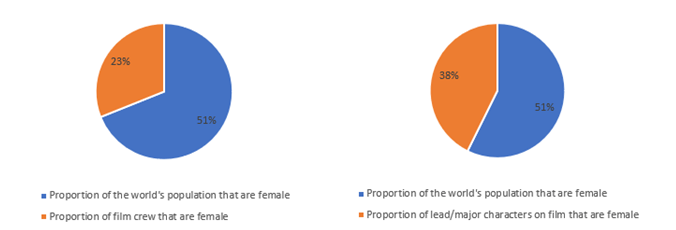
Film, and art in general, has long since had a symbiotic relationship with society as a whole; with film representing and reflecting society as it is, whilst simultaneously helping to shape the views and beliefs of its audience—not on its own of course, it doesn’t exist in a vacuum. That’s all in theory, because as we (the “we” in question being people of colour and/or women and/or the LGBTQ+ community in particular) all know, film doesn’t always reflect the world we live in to put it generously. To put it in more straightforward terms: the majority of films that are made in the West tend to be White, straight and male-centred despite the fact that the majority of people in the world do not fall under any of those demographics. For example, if we were to split the world’s population by either male or female gender (obviously gender is not binary…but let’s just pretend we all have a JK Rowling-level understanding of gender for argument’s sake), 51% of the world’s population would be female whilst 49% are male, and yet the statistics on the proportion of characters in film and television that are female don’t reflect these figures.
The annual report produced by the San Diego State University’s Center for the Study of Women in Television and Film showed that in 2020, just 29% of the top grossing U.S films featured female protagonists and women accounted for just 38% of major characters. The argument could be made that the report only looked at top grossing films, i.e. blockbusters, rather than indie films which generally have a greater proportion of female-driven stories (White female, that is, but that’s a whole other essay) but looking at general trends highlights that overall, there are more male-centric films than female-centric. If we look at the statistics for women working behind the scenes as directors, writers, producers, editors, cinematographers etc. the problem is even worse, with women comprising just 23% of these roles in the top 250 grossing films in 2020 according to a report out of SDSU looking at Women behind the scenes of films.
But don’t worry everyone! A mere 133 years since the first ever motion picture was shot and only now that MPAA data has shown that paying moviegoers are actually evenly split across genders, Hollywood is now working diligently to bridge this gap in gender representation in film. There has been a push to increase the proportion of female protagonists in high-grossing blockbuster films recently, in comic book movies in particular, since this is where historically there has been the widest gap. This push has meant over the last few years we’ve seen a handful of female-lead comic book film releases, but I am choosing to look at three films in particular; ‘Wonder Woman’ (2017), ‘Captain Marvel’ (2019), and ‘Black Widow’ (2021), which were hailed as huge milestones for female representation on a large scale and for their supposed feminist and empowering messages. Are these films a genuine step towards the representation of women as 51% of the world’s population, and do they really carry empowering messages at their core? Or, has Hollywood co-opted yet another social movement to employ innovative marketing tactics that attract more women to cinemas so they can make more money? Well…
Wonder Woman (2017)
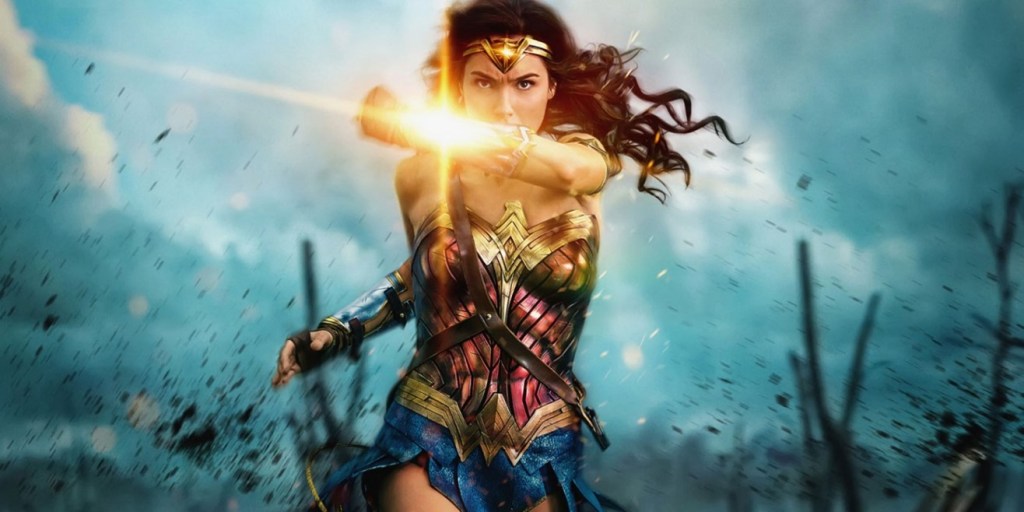
First, let’s look at the Patty Jenkins directed 2017 film, ‘Wonder Woman’. Despite being one of DC comics’ “big three” and arguably one of the most popular comic book characters of all time, the 2017 film was the first ever live-action film adaptation focused on the character; this is compared to the twelve live-action adaptations there have been for Batman and ten adaptations for Superman, the other two heroes that form part of DC’s big three. This coupled with the fact that aside from the likes of ‘Catwoman’ (2004) and ‘Elektra’ (2005)—films that were both critical and box office flops and just generally…bad—‘Wonder Woman’ was the first successful female-lead comic book film of the modern era of comic book films, making it something of a big deal when it came out. The film was met with high praise upon its release for having a female lead and being directed by a female director; and with the film being of a popular Intellectual Property (IP) and having such a big budget many were hopeful about how significant this could be for female representation, on screen and behind the screen.
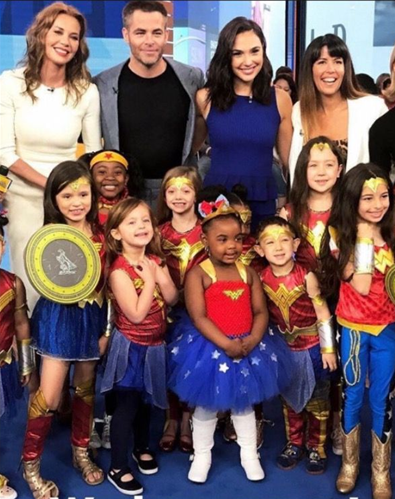
The film certainly made a splash upon its release in terms of the box office, where it grossed $223 million globally, breaking the record for the highest opening weekend for a film directed by a woman. ‘Wonder Woman’ was primarily an action film which meant it leaned into its representation of “strong women” (both the titular Wonder Woman and the women warriors from her home land Themyscira), but unlike other films that want a pat on the back for having “strong” female characters, the film didn’t just offer up a male action hero prototype gender swapped so they were in a skirt. Instead, ‘Wonder Woman’ offered up a hero who was both “strong” in the action hero sense but was also compassionate and gentle and “soft” and other descriptors that may be used for female characters often in a derogatory or reductive way; demonstrating that both things can and should co-exist when writing female characters. And it would be fair to say the film certainly resonated with audiences, including female comic book fans (because despite what male incel comic fans may lead you to believe, people that are female do in fact read comics) and most importantly, young children and girls who were given a popular figure they could aspire to. And I make special note of the latter because I personally believe that “representation matters” as a goal and slogan is limited, for one because it does not get into the specifics of the kinds of representation we should be seeking out, but also because representation should not be the be-all-end-all in the fight against inequality—we should not be fighting to “have a seat” at the table with the oppressor the way seeking out representation in a pre-existing media landscape implies, but rather to break the table and completely rebuild it. That being said, I do think that in the meantime representation has a place in the media children consume because seeing themselves represented gives them something to aspire to. In the case of ‘Wonder Woman’, it gave a lot of young girls a strong figure to look up to which I cannot take away from the film even if I am a hater.
But for as much as I have praised the film for the (baby) strides it made in terms of representation, once you look a little too closely at the supposed feminism and “girl power” message the film utilised in its marketing, you realise how very fallible it all is. Firstly, ‘Wonder Woman’ had an estimated budget of $120-$150million which is an ostentatious amount of money until you realise that ‘Man of Steel,’ the Superman-centric DC film from the same studio that came out a few years earlier in 2013, had a budget of $225million and ‘Batman V Superman: Dawn of Justice’ from just one year prior had an estimated budget of $250million. This highlights how comparatively less money is put into female-lead films than male-lead films, highlighting the wider issue that though Hollywood would like to pat itself on the back for all the work it’s doing towards increasing female representation on and off-screen, it’s still unwilling to put its money where its mouth is.
Additionally, Wonder Woman as a character and pop culture icon has long stood as a symbol of integrity and humanity, and of justice and equality. Wonder Woman has also always been a figure who fights for those who cannot fight for themselves and yet instead of opening up her purse and working with charity organisations to help those who had been laid off or had been made houseless because of this pandemic, the film’s star saw it fit to make a video with her famous friends lip syncing to John Lennon’s “Imagine”…for some reason. That’s not even getting into the other values of Wonder Woman that I mentioned before of “humanity” and “justice”; do you guys think it was humane or just of Gal Gadot to serve for the IDF? “But T…”, I hear you say, “Military service is mandatory in Israel.” Sure, I’ll give you that. But I don’t think continuing to post pro-IDF posts with hashtags such as #loveIDF onto social media of your own volition long after your conscription is mandatory, is it? Perhaps it’s unfair to expect an actor to uphold the values of a fictional character who is meant to represent all that is good about humanity, but if feminism and “girl boss” rhetoric is going to be used to market the movie to women and benefit from their buying power, I expect the film to uphold those values.
Captain Marvel (2019)
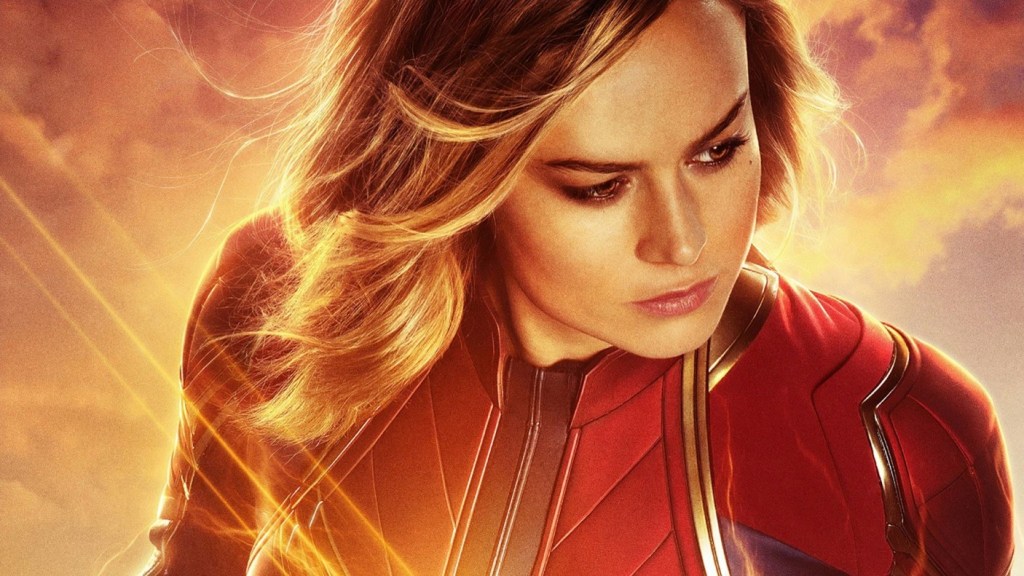
Despite the Marvel Cinematic Universe (MCU) launching in 2008 with ‘Iron Man’, it took eleven years for there to be a female superhero-lead MCU film; even DC ,which launched its own extended universe (DCEU) five years after Marvel, somehow beat them to having a female-lead film. Embarrassing. Unfortunately, what should’ve been a momentous occasion as far as female representation on the big screen goes soon became shrouded in “controversy” because a lot of people took issue with the film’s star Brie Larson speaking out about lack of racial diversity in film criticism. For some reason (the reason is misogyny with a dash of racism) her utilising her large platform to speak out about lack of diversity angered many so much so that people started leaving poor reviews for the film on Rotten Tomatoes before the film had even been released, and whenever a video with Brie Larson was released on YouTube people would barrage it with negative and sexist comments and leave a thumbs down in some attempt to “ratio” her, and when the film’s posters were initially released they were met with an onslaught of sexist comments about how Captain Marvel needed to “smile more”. Fortunately, the internet rallied together to drown out the sexist minority by overwhelmingly going out to see it and then talking about it, with the film going on to gross $1.128billion at the box office. The way people rallied together to fight against racist, sexist trolls to support a female-lead and female-(co)directed film was certainly something admirable and proved people’s willingness to watch and support female-driven films and stories.
However, as great as people working to prove sexist trolls wrong and wholeheartedly supporting a female-driven film may be, the contentious release of the film and the “discourse” from incels unfortunately obscured genuine criticisms that could be levied against the film. Namely, the fact that the film (like a lot of films in the MCU, including the ones with male leads mind you, lest you accuse me of double standards) was packed with military propaganda repackaged as “girl power” and (barely) hidden within the supposed feminist message of the film. If the fact that the film portrayed Carol Danvers’ home and family being almost entirely linked to the United States Air Force was too subtle for you, maybe the fact that the US Air Force quite literally ran recruitment ads before screenings of the film in the US and had a presence during a lot of the film’s press, including at its premiere, might convince you. The “Origin Story” ad they ran alongside the film managed to garner millions of views and worst of all, the Air Force saw an increase in the proportion of female applicants from 26.5% to 31.2% (source), meaning the propaganda actually worked.
As I said before, ‘Captain Marvel’ was neither the first nor last MCU film (and Hollywood film in general) to be so closely tied to the military, but the fact that in this particular case they framed military recruitment as something that is feminist is particularly insidious. Insidious because whilst the film uses the military to preach a message about women’s equality and empowerment, the military itself has actively worked to remove the rights and empowerment and general wellbeing of women globally in places such as Afghanistan, Iraq, Yemen and so, so many more through their endless invasions; highlighting how limited and non-intersectional this type of Hollywood “feminism” truly is. Furthermore, it’s insidious that this film helped drive up recruitment of female candidates under the guise of female empowerment when you consider that a report revealed that one in five service women were sexually assaulted since joining the service, (please keep in mind that these figures are based on those who actually reported it) and nearly 50% experienced sexist behaviours in general. Very feminist and empowering indeed.
Black Widow (2021)

Natasha Romanoff or “Black Widow” is a character who first appeared in the MCU as far back as 2010 in ‘Iron Man 2’ and for a long time was the sole female member of the Avengers team. Yet, unlike her male counterparts who formed the original line up of the live-action Avengers, it took until 2021 for her to get her own solo film in which she was the lead and got to do more than wear an impractical skin-tight suit/have a forced romantic storyline with the Hulk/lament about how her inability to have children somehow made her a “monster”. If you’re going to mention how another Avenger—Hawkeye, is only just now getting his own show I’m going to tell you right now: we don’t care. ‘Black Widow’ was a major moment for a character who had long since been relegated to nothing more than a sex symbol (even by her own co-stars), exploring her past to show the unspeakable things she had done before all the good she did with the Avengers—and as a result, showing how female characters in major films could be morally grey and complex and other characteristics normally reserved for male protagonists and anti-heroes. The extent to which the film presented the complexities of Black Widow the character was limited, especially when compared to the character’s comic history, but I have to give them some credit for making an attempt to write a female character that was three-dimensional and multi-faceted within the context of such a huge blockbuster; it’s good to have more female representation on screen, but there should be a whole variety of women who are shown—women that are “good” and soft, women that are antiheroes, women that are villains, women that are “evil” and so much more.
Beyond paying dues to a deserving character (emphasis on character) after all the terrible writing and mistreatment at the hands of the likes of Joss Whedon, the film was also significant as its core message was all about trafficking and the need to protect girls across the globe as highlighted by a scene in the films opening credits and again at the film’s climax. But whatever sort of empowering message could’ve been derived from the scenes in question is completely undermined when you consider the fact that whilst Scarlett Johansson was reciting lines about protecting girls as her character Black Widow, in real life she very much does not stand for protecting girls. For one she has not only worked with known Hollywood predator Woody Allen in ‘Match Point’, ‘Scoop’ and ‘Vicky Christina Barcelona’ (if one time is a mistake…what is three times?), but has defended him even as recently as 2019 and talked publicly and candidly about her love for the man where others in Hollywood have gone on to express regret for appearing in even one of his films. Woody Allen is not the only predator Scarlett is fond of, she has no issue with Roman Polanski and during the press tour for ‘Black Widow’ itself (in 2021!) expressed her love and support for Joss Whedon despite all the abuse allegations that have come out against him. Even if she doesn’t care about other women at all, you’d think the fact that for years Joss Whedon butchered the character of Black Widow with terrible writing and sexist tropes might be enough to not support him. Point being, it’s very difficult to take Scarlett Johansson or the film as a whole seriously as it preaches to the audience about how we must protect girls and women knowing that the person delivering those lines fiercely stands by men who prey on and harm women and girls—just as it was very difficult to take Scarlett Johansson seriously as she spoke at a Time’s Up rally about the ongoing abuses within Hollywood (an organisation that is rife with its own issues making this triply ironic) during the height of the #MeToo movement back in 2018. If you’re going to preach to me about the empowerment of women and take my money to go and see your little film at the very least don’t support predators yourself, maybe?
In conclusion…
Overall, there is clearly still a long way to go when it comes to gender representation on screen no matter how much Hollywood is pushing the idea of representation and empowerment to get women in those cinema seats. And that’s not even getting into the issue of how even with the few female-lead blockbusters and comic book films we’ve had, with their problematic versions of “feminism” and all, all of them have been led by white women and there are none where women of colour are at the centre in front of or behind the camera…but that’s a whole other essay on its own. It should be noted that the upcoming Captain Marvel sequel ‘The Marvels’ will feature a Black woman and a Brown girl as co-leads and is directed by a Black woman, but it’s not lost on me that the two WOC were only able to be leads alongside a white lead (Brie Larson). Baby steps.
The three films I’ve discussed here are, unfortunately, only a few out of a lot more films that form part of an ongoing trend featuring this superficial Hollywood version of feminism and female empowerment designed solely for the purpose of capitalising on the fact that women go to watch films just as much as men do (and maybe in classic “And another thing…” fashion, I may turn “Hollywood Feminism” into a series). To be clear, the point of this whole essay was not to say you’re a bad woman or feminist if you enjoyed any of the films I talked about here and it was definitely not to say the basement-dwelling incels who hate on these things simply for having women at the centre have a point; I am just making it clear that we should remember that feminism at its heart and core is a liberal social movement looking to make tangible progress for women of all races, socioeconomic class, ability etc. and not a marketing ploy Hollywood can use under the guise of empowerment and representation of women—when in reality that representation is White, and both purposefully and inadvertently pushes imperialist ideas to its audience as “girl power”.
We should demand better if Hollywood wants our coin so bad.

 Small, Silver and Hardback
wow!! 106Everything I’ve watched and read while sick
LikeLike