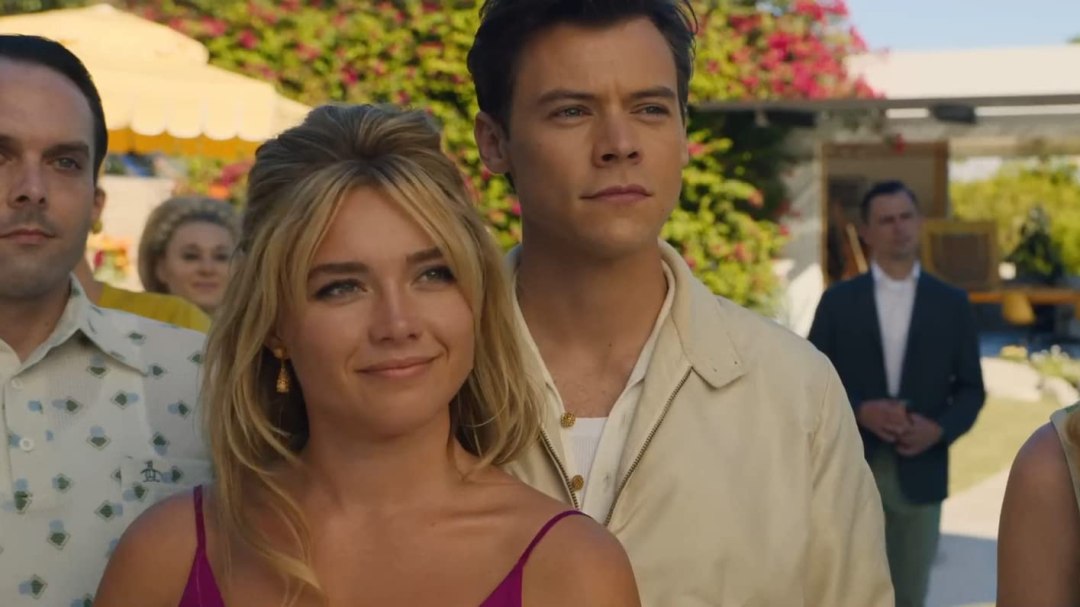

The term “second-wave feminism” was first brought into the zeitgeist by New York Times journalist Martha Weinman Lear in a 1968 article. Where first-wave feminism had focused primarily on women’s suffrage, second-wave feminism was more a response to the position women found themselves following World War II when men returned home and women had to return to their place in the household and leave the workforce positions they had occupied during the war. Our blog may not have a large readership, but I like to think of our small readership as possessing critical thinking skills so hopefully none of you are asking why you’re getting a lesson on women’s history when you just came here to read a review on ‘Don’t Worry Darling’, but it is relevant of course. Outside of all the various controversies surrounding this film and its cast and crew (controversies and gossip that I will not be touching on in this review because that’s literally none of my business, sorry), this film has been largely marketed as being feminist with its director Olivia Wilde giving interviews in the run up to the film’s release stating that even the sex scenes of the film were supposedly feminist (I don’t know how scenes where two actors stimulate having intercourse, and in particular scenes where in context of the film one character doesn’t have the agency to fully consent, can be “feminist” but okay, sure Olivia). With the marketing pushing the idea of this film being some sort of feminist fable it is therefore important to examine how that feminism measures up along with contextualising it within women’s history and feminist theory as a whole.
To circle back to second-wave feminism; the seminal work that defined this era of feminism, at least in the USA which I’m choosing as my focal point for this review as ‘Don’t Worry Darling’ is set in the USA, was ‘The Feminine Mystique’ by Betty Friedan. Within this book, Friedan who at the time she wrote the novel was a housewife after years spent working as a writer, examined the way in which women of the time were deeply unhappy and unsatisfied being taken from the workforce and being made into housewives. Friedan’s novel went on to sell millions of copies and became something of a call to action for women of a similar demographic to her– White and middle class. Had Olivia Wilde not outright spoken about how she and her writing partner for the film, Katie Silberman, took direct inspiration from Friedan’s work the inspiration would be clear nonetheless. The climax of the film– spoiler alert!– involves the reveal that the idyllic town of Victory is nothing more than a simulation which the male characters have trapped the women in to force them to be their doting housewives who stay at home whilst the men go off to work, upholding those same patriarchal gender roles that Friedan spoke of as wasting the potential of women everywhere. And if that didn’t hammer in the Friedan of it all, our protagonist Alice (Florence Pugh literally carrying this film), angered at her discovery of what Jack (played by the completely uncharismatic Harry Styles) has done, admonishes him and shouts about how she had her “work” and a “life”, with which she was satisfied, before he trapped her in the house/Victory.
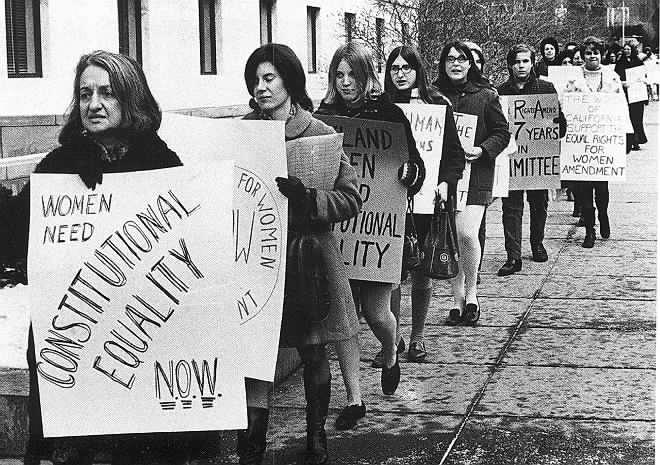
I’ve alluded to how Friedan’s novel focused on women of the same demographic as her, which is to say everything in her work and the subsequent movement it inspired were almost entirely only applicable to White women who were socio-economically well off (middle class and up). I’d recommend reading Angela Davis’ ‘Women, Race and Class’ as it explores all this in depth, but the idea of all women being dissatisfied due to being taken out of the workforce and that being a central focus of second-wave feminism completely ignored women of colour and/or working class women who continued to work even after the war as their households needed more than one income to survive. In fact, a lot of Black women and women of colour actually worked as housekeepers, nannies etc. in the households of the kind of unsatisfied housewives that were the focus of Friedan’s work. This is a general criticism levied against second-wave feminism in general; the way that the concerns and needs of women who were not White, heterosexual, able-bodied and socio-economically well off were ignored within the mainstream movements. It’s an issue that was present with each era of feminism and lead to the rise of alternative feminist movements such as Black Feminism throughout history, and it’s the reason why intersectionality is such an important framework through which to look at not just feminism, but all civil rights movements.
Just as Friedan’s work failed to consider how the concerns of a White middle class woman might differ to those of a woman who isn’t either of those things, this film also fails to consider how a place like Victory– a Utopia that’s essentially based on Jim Crow era America– would have other systems of oppression in place that go beyond gender. It would be bad enough if the film had just pretended that a place based on 1950s America could ever exist as an aracial place where the race of its residents is never an issue, but the film does something even more sinister in how it treats Margaret (played by the slighted but always incredible Kiki Layne) who serves as not just the only named Black woman in the cast, but is also nothing more than a plot device to move Alice’s story along whilst we never learn much about her as a person both within Victory and outside of it. Or, if we did learn more about the character then it was probably cut (this excellent review went into more depth about Margaret’s character and how she feeds into the age old trope of the Black martyr). But I guess whilst those new Academy rules said you had to have a diverse cast to be eligible for nominations, they didn’t specify that you needed to flesh out the characters of your actors of colour so why bother, right?

Beyond its problematic handling of race, the film also falls short in how it fails to effectively modernise Friedan’s work to make the themes feel relevant to feminist issues of today. I guess an attempt is made with the character of Frank (Chris Pine), who is a very clear and unsubtle stand-in for Jordan Peterson. For those that have no idea who that is I’m sorry to take you out of your blissful ignorance, but Peterson is a former Psychology professor and clinical psychologist who first gained a following after publishing a YouTube video in which he raged against an amendment to add gender identity and expression to the Canadian Human Rights Act (the so-called Bill C-16). As you can figure from the premise of that video alone, he has built a platform based on him decrying leftism and “wokeism” and has gained a large following consisting largely of White men who feel somehow slighted by a society that is moving towards equality and diversity. Frank is a clear stand-in for Peterson not just in how he builds this virtual reality which enforces patriarchal gender roles, but even in things like how he handles Alice’s attempts to expose him and Victory. There are a frightening amount of videos on the internet with titles like “Jordan Peterson calmly dismantles feminism in front of two feminists”, or “Jordan Peterson Puts Feminist in Her Place”, or “Dr Jordan Peterson gives up on trying to reason with SJWs” with millions of views (I’m not going to link them and you should not look them up either). The aforementioned videos frame Jordan Peterson as the level-headed intellectual who knows what he is talking about, arguing against feminists and leftists (who are almost always women) who are framed as being hysterical with arguments not based on facts and research but just on emotion. This is a dynamic shown in a scene which is one of the turning points of the film in which Alice tries to make the other Victory residents see that Frank is lying to them all and Victory is not what it seems, but no one believes her. I am not reaching when I make these comparisons for Olivia Wilde has said herself Frank is inspired by Peterson, and has spoken about Silberman and herself scouring YouTube, 4chan etc. to explore the “disenfranchised world of white men on the internet”.
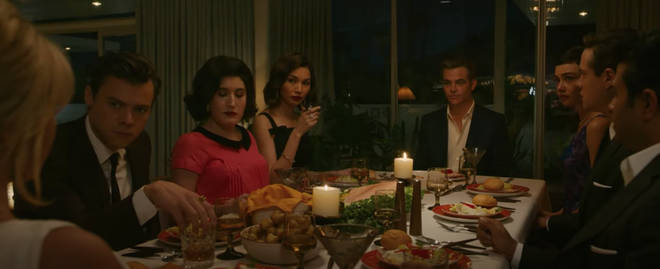
People such as those who are dedicated followers of Peterson undoubtedly believe in conservatism and traditional gender roles, so in exploring the idea of enforced patriarchy and its impact on women as in the work of Friedan and pairing that with a Peterson-like figure in Pine’s Frank, what exactly is this film’s supposed take home feminist message? To shine a light on these once fringe far-right internet subcultures which are garnering increased popularity, and what a danger they are to women? I guess I can give the film a little credit in saying this could be timely message as there’s a rise in repackaged far-right talking points about gender roles in the form of the viral tweets or tiktoks (as with the Peterson stuff, I’m not linking stupidity) which blame feminism for women having to work exhausting jobs when they would rather lead leisurely lives without having to worry about money while ignoring the importance of the financial freedom women gained by joining the workforce and ignoring the real culprit behind women’s (and people in general) frustration at having your entire life revolve around work being capitalism not feminism; but the film doesn’t communicate that to its audience in a way that feels definitive or ever quite coalesces after the big reveal. I also feel that most women who would call themselves feminist, and certainly the kind of women that I think Olivia Wilde and Katie Silberman thought of as the target audience of this film would know how this kind of thing is a danger to women without having it spoon-fed to them through this simplistic film.
For the ultimate messaging of your film to be “traditional gender roles are bad for women” at a time where the advent of intersectional feminism and the diversification of feminist voices and work means that Western feminism is no longer looked at with such a simplistic view, and through the lens of just White, middle class women is so greatly disappointing. I’d go even further to say that to make a film that has so little of relevance to say and to add to the modern landscape of feminism and feminist media when you’ve gone on record saying, “I don’t enjoy or feel inspired by stories that oversimplify feminism”, is laughable, even. I think this film would be much more revelatory and eye opening if I were a White, middle class woman living in the 1960s but I am not, so…
The verdict: 5/10
-T


such a fun read. i have not watched this wrecj of a film (…and honestly didn’t plan to) but i now know with some certainty that nothing that film could’ve done would be more enjoyable than this review! great stuff as always
LikeLike